
Sahuarita, Arizona: The Family Master-Plan Town South of Tucson
Sahuarita is the Tucson metro's young-family counterweight — an incorporated town of about 37,700 people (U.S. Census Bureau estimate, July 1, 2025) in the Santa Cruz Valley, roughly 20 miles south of downtown Tucson on I-19. It grew up around Rancho Sahuarita, a lake-and-clubhouse master plan, and around one stubborn advantage: a median owner-occupied home value of $364,300 (Census Bureau, 2020–2024) — right at Tucson's own median — paired with a median household income of $104,680, one of the highest in the metro. The trade is distance: most residents commute north, and the town's own job base is still catching up with its rooftops.
 By Marisol Rodriguez, editor & host of TucsonBound
What Sahuarita actually is
Unlike its southern neighbor Green Valley, Sahuarita is a real town — incorporated in 1994, with a mayor, a town hall, and a population that has climbed from 25,259 in the 2010 census to 34,134 in 2020 and an estimated 37,694 by mid-2025. That growth is not retirees. Sahuarita's center of gravity is young: subdivisions full of first and second homes, stroller traffic on the trails, and school enrollment that keeps the Sahuarita Unified School District building. About 81% of homes are owner-occupied (Census Bureau, 2020–2024), which gives the town a settled, invested feel despite how new much of it is.
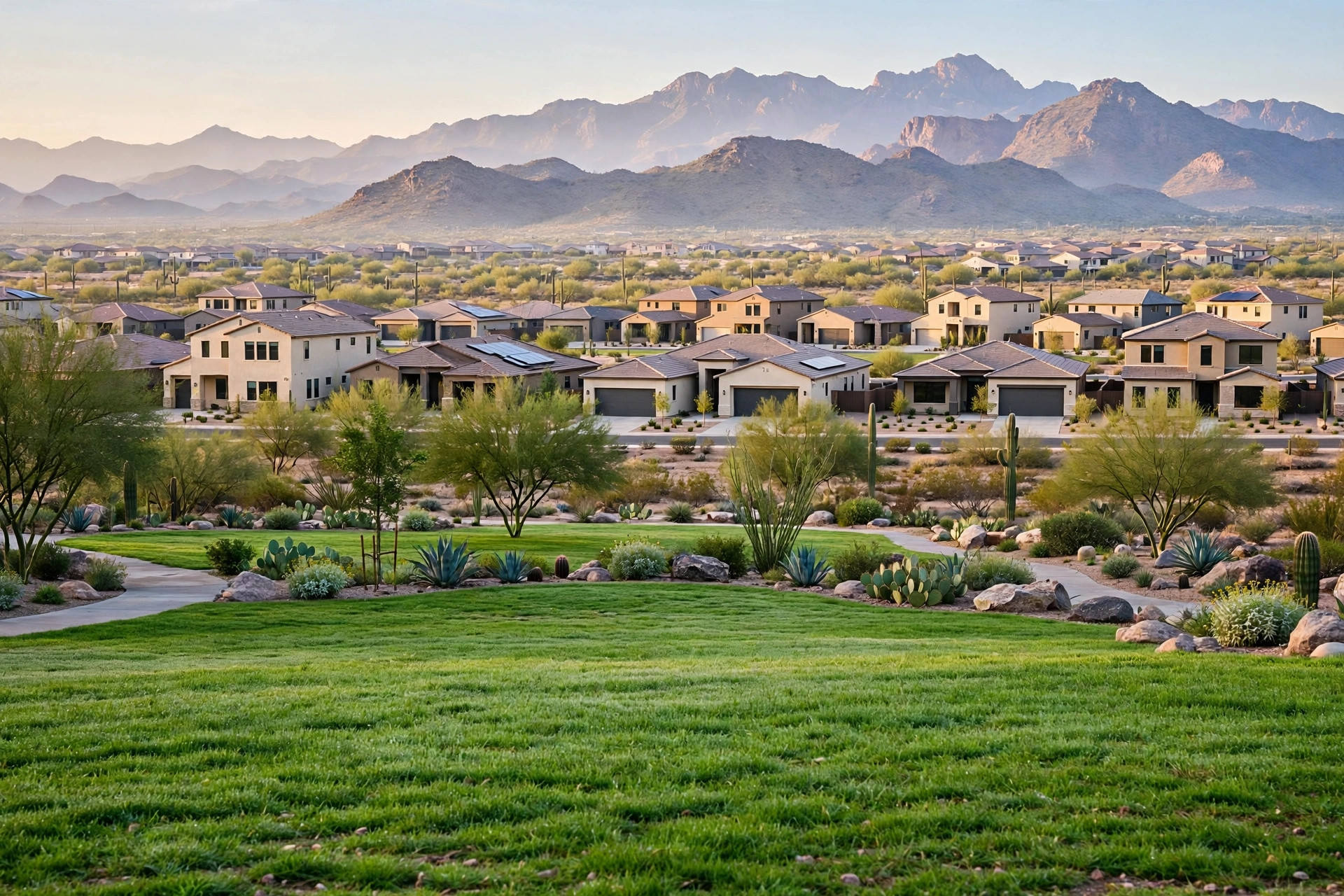
Geography is the pitch and the caveat in one. Sahuarita sits in the Santa Cruz Valley with the Santa Rita Mountains to the east — the same range that backs Green Valley — and pecan groves and desert along the river corridor. Downtown Tucson is about 25–30 minutes north on I-19 in normal traffic; Tucson International Airport and the south-side employment corridor (Raytheon, Davis-Monthan's orbit, the hospital and logistics employers) are closer, which is why so many Sahuarita commutes end on the south side rather than downtown. Our South territory guide maps how Sahuarita and Green Valley split the valley between them.
Rancho Sahuarita is the headline
Most of the town's growth orbits Rancho Sahuarita, the master plan built around an 11-acre lake, a large clubhouse with fitness and pool facilities, parks, trails, and a year-round events calendar — concerts, markets, holiday events — that does the social organizing for you. For families relocating cold, that calendar is the real amenity: it is how newcomers meet neighbors in the first ninety days instead of the first year. Newer sections keep extending the plan south and east, so a meaningful share of Sahuarita's listings at any moment are new builds, with the builder warranties and the HOA dues to match — price the dues into the monthly math, not as an afterthought.
Outside Rancho Sahuarita, the town layers in other subdivisions at a range of price points, plus the town's second identity entirely: Quail Creek, the Robson 55+ resort community on the town's southern edge, which we compare head-to-head with SaddleBrooke and Sun City Oro Valley in the 55+ communities guide. One town, two demographics — young families in the master plans, active retirees at Quail Creek — and the shared infrastructure (grocery, medical offices, the I-19 corridor) serves both.
What homes cost and what you get
The Census Bureau puts Sahuarita's median owner-occupied home value at $364,300 (2020–2024), and recent resale and new-build medians commonly land in the mid-$300,000s to low $400,000s depending on subdivision and size — against about $555,000–$580,000 in Oro Valley and roughly $410,000 in Vail. What the money buys here is newness: the typical Sahuarita home is a single-story or two-story stucco build from the last two decades, three to five bedrooms, desert or low-water landscaping, and a community pool and trail system down the street. Median gross rent is $1,837 a month (Census Bureau) — not cheap, because the rental stock is mostly single-family homes rather than apartment complexes; families who want to rent before buying should start that search early.
Run the family comparison the way our best neighborhoods for families guide does. Sahuarita is the budget pick that does not feel like a compromise — the most master-plan amenity per dollar in the metro. Vail costs more and answers with the region's top-rated school district. Marana costs more again and puts you on the northwest job corridor instead. On the southwest side, Valencia West runs the same new-subdivision math without a town wrapper — worth a look if your work is on the south side and Sahuarita feels a shade too far out. If your workplace is on Tucson's south side or fully remote, Sahuarita's math is hard to beat; check the live numbers in the monthly market report before you tour.
Schools, services, and the honest trade-offs
Sahuarita Unified School District is the town's own district — a genuine point of difference from unincorporated suburbs that borrow a neighbor's schools — and it draws good marks from relocating families; our Tucson schools guide explains how to check the current state report card for any specific campus before you buy. Day-to-day life is complete inside the town: grocery stores, medical and dental offices, banks, chain restaurants and services cluster along the main corridors, and Green Valley — ten minutes south — adds its own clinics, stores, and the Titan Missile Museum, the preserved Cold War missile site on Duval Mine Road that is the valley's signature history stop.
Be clear-eyed about the three recurring costs. Commute: if your job is at the University of Arizona, downtown, or the Foothills, you are signing up for 35–50 minutes each way at peak — test it at rush hour before you fall for a floor plan. Thin local jobs: Sahuarita is a bedroom community by design; most working residents leave town each morning. Summer and sameness: the master-plan formula means newer, similar housing stock and full desert heat, with the community calendar — not a downtown — as the social engine. None of these are surprises to anyone who tours honestly, and for the families who choose it, the package still wins.
Who Sahuarita fits, and who it does not
Sahuarita fits families who want a newer home, a real town school district, and a built-in social calendar at a Tucson-median price — especially south-side and remote workers. It does not fit buyers who want historic character, a short commute to the north side, or an older, tree-shaded street; those buyers belong in town or in the Foothills, and our best suburbs comparison puts all five ring communities side by side. When families ask me where the metro's value hides in 2026, Sahuarita is the first name I give them — with the commute test attached.
At a glance: Location: incorporated town, Santa Cruz Valley, ~20 miles south of downtown Tucson on I-19. Population: 37,694 (Census Bureau estimate, July 1, 2025). Typical prices: median owner-occupied value $364,300 (Census Bureau, 2020–2024); medians commonly mid-$300,000s to low $400,000s. Character: young, family-heavy, ~81% owner-occupied, anchored by Rancho Sahuarita; Quail Creek 55+ on its southern edge. Best for: families who want master-plan amenities at a Tucson-median price. Watch for: HOA dues in the monthly math, the northbound commute, and a thin local job base.