
Valencia West, Arizona: New Homes Where Tucson Meets the Open Desert
Valencia West is the Tucson metro's southwest growth story — an unincorporated community in Pima County (ZIP 85757) that grew from 2,380 people in the 2000 census to 14,101 in 2020 (U.S. Census Bureau), almost all of it in subdivisions built since the 2000s along the Valencia Road and Ajo Highway corridors. It is neither a resort address nor a historic one. It is where Tucson's working families have been buying new and newer homes at the desert's edge — the Tucson Mountains on the horizon, Saguaro National Park West up the road, downtown roughly 25 minutes northeast — and the builders have not finished: Meritage Homes' Sunset Crest at Ajo and Kinney was selling 2026-built homes this fall.
 By Marisol Rodriguez, editor & host of TucsonBound
What Valencia West actually is
Start with what it is not: Valencia West is not a town. Like the Catalina Foothills, it is an unincorporated census-designated place — about ten square miles of Pima County with no mayor, no town hall, and no municipal services department. County government runs the roads and the sheriff patrols them, and the community's identity comes from its subdivisions and its two corridors rather than from any civic center. West Valencia Road is the spine; Ajo Highway (State Route 86) cuts across the south end on its way to Ryan Airfield and, eventually, Sells and the border country. Midvale Park and Drexel Heights — older, in-city Tucson — sit to the east; open desert, the Tucson Mountains, and Pascua Yaqui land frame the west and south. Casino Del Sol, the Pascua Yaqui Tribe's resort, is a few minutes west on Valencia Road, and it functions as the area's unlikely anchor tenant for dining and entertainment.
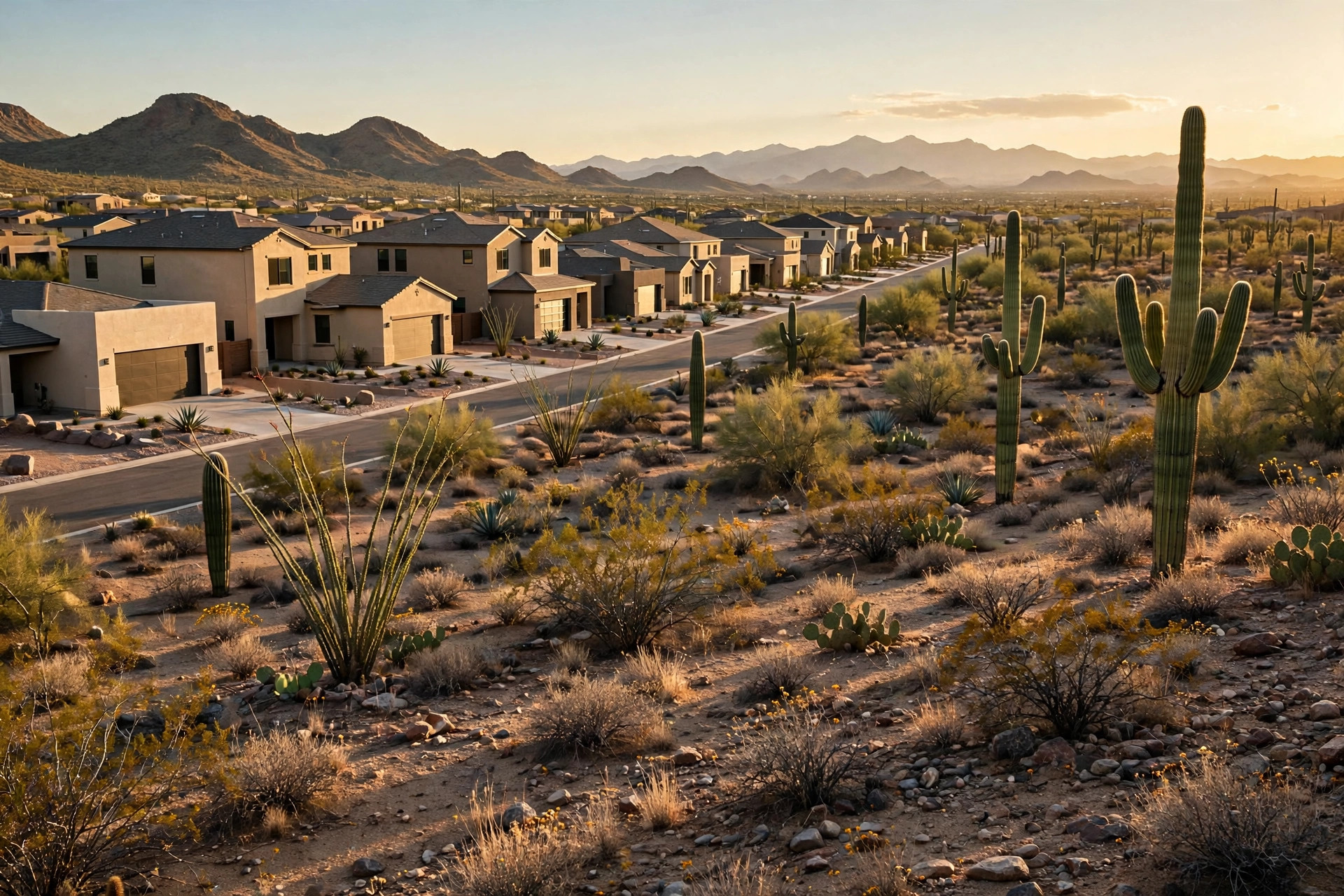
The feel follows from the map. This is the edge of the city in the literal sense: subdivisions with stucco-and-tile production homes give way, sometimes within a block, to undeveloped desert, rural lots, and mountain views that have not been built in front of yet. Buyers cross-shopping the incorporated growth towns should read this page alongside our Sahuarita guide — Sahuarita is the same growth story with a town government wrapped around it — and the best suburbs comparison, which puts the ring communities side by side.
Why movers keep finding it
The numbers explain the gravity. A community that goes from 2,380 residents to 14,101 in twenty years — nearly sixfold — is a community the market has voted for, and the vote is about one thing: the newest housing stock per dollar on Tucson's west side. Nearly a third of residents are under twenty (Census Bureau, American Community Survey 2020–2024), which is the demographic signature of first- and second-home buyers, not retirees. When buyers tell me they want a newer home, a real yard, and a payment that leaves something over at the end of the month — and they do not care whether the address impresses anyone — Valencia West is where that search usually lands.
It also sits better than its reputation suggests. Valencia Road runs east in a straight line to Tucson International Airport and the south-side employment corridor; Interstate 19 is minutes east for the run downtown or south toward Sahuarita and Green Valley; and the Ajo Highway puts the far west side — Ryan Airfield, Saguaro National Park West, the Arizona-Sonora Desert Museum — in the home team's backyard rather than across town. Our cost of living guide breaks down what that southwest-side math looks like month to month.
Homes and subdivisions
The housing is young by Tucson standards. The dominant product is the 2000s-and-newer production subdivision: single-story and two-story stucco homes with tile roofs, three to five bedrooms, walled backyards and HOA-kept common areas, built by the national and regional builders who work every growth corridor in the metro. New construction is still live — Sunset Crest at Ajo and Kinney, a Meritage Homes community with a playground, picnic ramadas and desert landscaping, was selling newly built homes in 2026 — so buyers can still choose between a builder's warranty and a resale discount on the same few streets. Away from the corridors the texture changes: older rural-residential pockets, some manufactured homes, and larger lots that predate the subdivision era. That mix is worth knowing before you tour, because "Valencia West" on a listing can mean a 2024 build in a master-planned section or a 1990s home on a dirt-road lot, and the two are priced — and financed, and insured — differently.
Schools and daily life
Valencia West is served by the Tucson Unified School District, the metro's largest — a point of difference from the suburban districts in Marana, Vail and Sahuarita, and the thing family buyers should research most carefully here. TUSD is big enough to contain both destination magnet programs and ordinary neighborhood campuses, so the specific school a specific street feeds into matters more than the district's average; our Tucson schools guide explains how to pull the current state report card for any campus before you buy. Daily life runs on the corridors: grocery, pharmacy, banking and chain dining cluster along Valencia Road and at the Midvale Park shopping areas to the east, and most residents treat the southwest side as home base while driving east or north for the bigger retail. It is a car-dependent community in the full sense — budget for two vehicles and short drives for almost everything.
The west side's backyard
What Valencia West lacks in a town center it partly repays in geography. Saguaro National Park's west district — the densest saguaro forest in the metro — is an easy drive north, with the Arizona-Sonora Desert Museum and Old Tucson just beyond it; Gates Pass, the sunset pass through the Tucson Mountains, is the locals' route to all three and a destination in its own right. Casino Del Sol covers the resort-and-concert slot a few minutes west. None of this is walkable, and none of it is in the community — but as a weekend radius it beats most of the metro, and it is the honest answer to "what do people do out there." Our day trips guide covers the west-side circuit in full.
What it costs and what you get
You are buying newness and space rather than address prestige. The metro-wide median sale price has been running around $360,000–$370,000 (MLSSAZ figures, tracked monthly in our market report), and Valencia West's proposition has consistently been a newer home — often a decade or more newer — for money that buys older stock in the established parts of town, with the Foothills and Oro Valley premiums nowhere in the math. What the money does not buy is separation from the growth itself: new phases keep opening, so a view lot today may have a new street behind it tomorrow, and the newest sections carry the newest HOA dues. Buyers comparing new-build against resale should work through our buying a home in Tucson guide before touring either.
The honest trade-offs
Four costs come with the value. First, unincorporated means unincorporated: no town recreation department, no municipal pool or library branch of its own, and road and service upgrades that move at county pace while the rooftops arrive at builder pace — the gap shows in places. Second, the commute is directional: south-side and airport-corridor jobs are close, downtown is a fair 25 minutes, but the University of Arizona at rush hour, the Foothills, or Davis-Monthan across town are genuine drives, and there is no freeway on the west side to shorten them — test yours at peak. Third, retail still trails rooftops: the everyday basics are covered, but the southwest side drives east for the rest, and that errand run is a permanent feature of living here. Fourth, it is the desert's edge: summer heat arrives unfiltered, dust and wind are west-side facts, and the wildland edge that makes the sunsets also means coyotes, javelina and the occasional construction zone as the next phase grades in.
Who Valencia West fits, and who it does not
Valencia West fits first-time and move-up buyers who want the newest home their budget can reach, families who want yard and square footage inside Tucson Unified's orbit, buyers who work the south side or remotely, and anyone who would rather have Saguaro National Park than a prestige ZIP. It does not fit buyers who want a walkable old-town streetscape, a town's worth of amenities at the end of the street, or a short commute to the east side. When buyers ask me where Tucson is still building the classic starter-home subdivision — stucco, tile, two-car garage, desert at the end of the street — this is the answer, with the county-services caveat attached.
At a glance: Location: unincorporated Pima County community (ZIP 85757) on Tucson's southwest edge, along Valencia Road and Ajo Highway. Scale: ~10 square miles; population 14,101 (2020 census), up from 2,380 in 2000. Homes: mostly 2000s-and-newer production subdivisions, with new construction still selling (Sunset Crest at Ajo & Kinney, Meritage Homes, 2026) and older rural-lot pockets away from the corridors. Schools: Tucson Unified School District — check the specific campus. Character: young, family-heavy, car-dependent desert-edge suburb; Casino Del Sol minutes west; Saguaro National Park West up the road. Best for: first-time and move-up buyers, south-side commuters, value-first families. Watch for: county-pace services, cross-town commutes, retail still catching up, and growth continuing around you.